
Signage terminology: a glossary for sign buyers
Each term is defined the way we use it on drawings, mockups and product pages, with a link to the page that shows it built.
Signage terminology varies from shop to shop. Our own order records tag the same reverse lit letter “back-lit” on some orders and “halo lit” on others. This glossary gives each term one meaning, so you can mark a drawing in the words we build to. It covers letter and sign types, lighting, mounting, the parts of a letter, and the files you approve before production.
Letter and sign types
Channel letters
Also called: built-up letters (UK).
Channel letters are hollow: the LEDs and their wiring sit inside the letter, and the set runs from a power supply. We build them front lit (face-lit), reverse lit (halo-lit), trimless or open face, with returns to your spec.
Dimensional letters
Also called: non-illuminated letters; flat cut letters (UK).
Dimensional letters are cut from solid acrylic or fabricated from metal, and neither carries wiring or a power supply.
Open face (marquee) letters
Also called: marquee letters.
Open face letters are metal channel letters open at the front, no acrylic face; round LED bulbs mounted through the metal face and visible from the front; indoor use.
LED backlit metal letters & logos
One flat metal sheet cut to the outline of the logo, with the LED strip behind it; the metal reads dark and the light falls on the wall. We don’t call the flat metal logo “reverse lit”.
Lightbox
Also called: sign cabinet, light box.
A lightbox is a metal cabinet with a printed polycarbonate face or liner, lit from inside. The cabinet stays the same; what changes is the face and where the light comes out.
Desktop sign
A desktop sign is built from the same metal, acrylic and LED as our wall signs. It stands on its own base.
Elementa sign
Elementa is a face set that fits over a 3D backlit sign. Faces change for each season and holiday.
Lighting: front lit, reverse lit and backlit metal effects
Front lit
Also called: face-lit.
The face of each letter lights; the returns stay dark, with no glow on the wall behind.
Reverse lit
Also called: halo-lit; halo illuminated letters (UK); back-lit.
Solid metal face, LED modules firing back through a frosted acrylic base onto the wall; letters stand off the wall on threaded studs, or sit on a backer panel. The wall glows; the face reads as a silhouette.
Silhouette and glow
Silhouette, multi-layer and glow start the same way: a metal sheet cut to the outline, with an LED strip behind it.
Multi-layer
Two or more metal layers stacked in one piece; the rear layer hides the wiring and stiffens the sign.
Neon flex
Neon flex is LED strip in a flexible PVC sleeve, bent to the lines of the logo and mounted on a clear acrylic panel.
Mounting: raceway, backer panel, flush and studs
Raceway
One painted raceway carries the letters, the LED wiring and the power supply.
Backer panel
A backer panel is one panel, all wiring behind it. Your crew mounts it and connects power.
Flush mount
A front lit letter has a back that your crew screws to the wall first; the letter then closes over it and locks with screws on the side.
Stud mount
Also called: threaded studs.
Stud mounting means each letter hangs on threaded studs in its back, set into holes drilled in the wall, with nothing showing on the face.
Blade bracket and double-sided cabinet
On a double-sided cabinet both faces are printed and lit, as on a blade bracket or a cabinet hung on cables.
Parts of a letter: face, return, trim cap
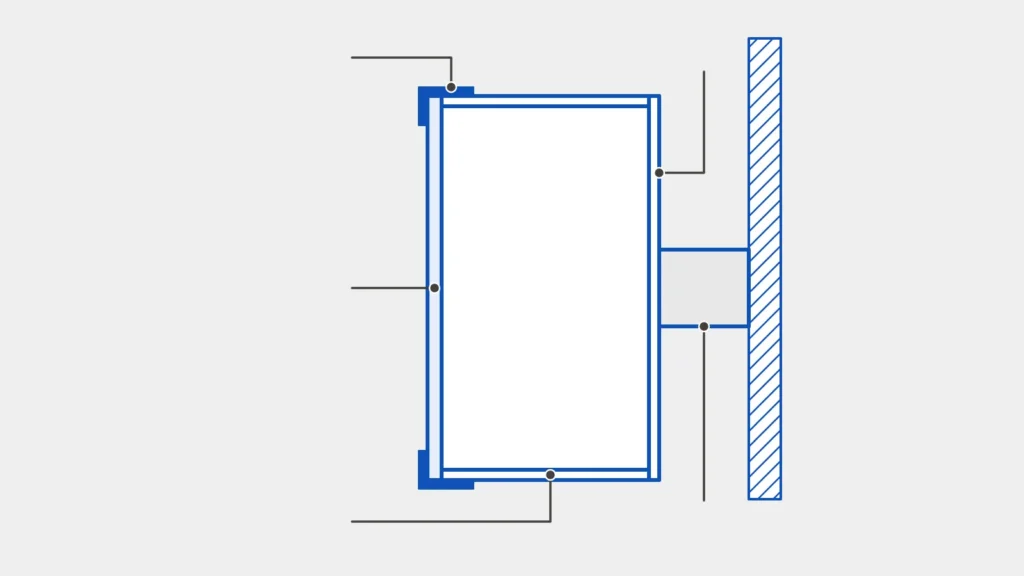
Face
A fabricated metal dimensional letter and a reverse lit (halo-lit) channel letter both show a solid metal face. A front lit (face-lit) channel letter shows a printed polycarbonate face behind a stainless rim.
Return
The return is the side of a fabricated letter, between the face and the back; it gives the letter its depth. A channel letter has returns, painted to your spec.
Trim cap
A trim cap is the plastic edge that holds an acrylic face into the return; you see it as a line around the face.
Trimless
A trimless letter has no cap, so the face meets the return as one edge. We build trimless letters to your drawing.
Files, approvals and checks before a sign ships
Mockup
You approve a mockup before production: the sign on your site photo or as dimensioned artwork, with overall size and lighting type.
Engineering drawings
You approve the mockup; we work out the engineering. Need engineering drawings for a permit? We prepare them as an add-on.
1:1 pattern
Dimensional letters ship with a printed 1:1 paper pattern, channel letter crates carry one too, and LED backlit metal signs ship with a 1:1 drilling pattern in the box. Your installer marks and drills from it instead of measuring each letter.
Install-ready
An install-ready sign ships with its raceway or backer built where the drawing calls for one; your installer hangs it. Every channel letter crate also holds the 1:1 paper pattern, mounting hardware, mounting drawings and the install guide.
Lit test
Illuminated signs are lit-tested: powered on and photographed before packing. A non-lit set is photographed finished.
UL Recognized and UL-listed components
LED modules and power supplies are UL Recognized / UL-listed components. If your client’s city or landlord requires a UL label on the complete sign, tell us before production.
PMS and RAL codes
Give paint colors as PMS or RAL codes, not names; we match to the code.
Sign schedule, style guide and elevation
Send the floor plans, site photos and your brand standard; we return a numbered sign schedule, a style guide and an elevation for every sign for approval.
Questions about signage terms
What are the letters on a building called?
Lit letters with the LEDs inside are channel letters. Letters with no wiring, cut from acrylic or fabricated from metal, are dimensional letters.
Is a backlit metal logo the same as reverse lit letters?
No. Both light the wall, but the metal logo is a single flat sheet lit by LED strip, while the channel letter has a solid face, returns and LED modules inside.
Send the request
Send the artwork and the quantity. You get a quote within 24–48 hours and a mockup for approval.