
This guide is for the estimator putting a few letter options in front of a client, and for the architect deciding which one goes on the elevation.
Channel letters are hollow: the LEDs and their wiring sit inside the letter, and the set runs from a power supply. Dimensional letters are cut from solid acrylic or fabricated from metal, and neither carries wiring or a power supply. So the first question for your client is whether the name has to read at night. If it does, quote channel letters. Mounting and budget come after that answer.
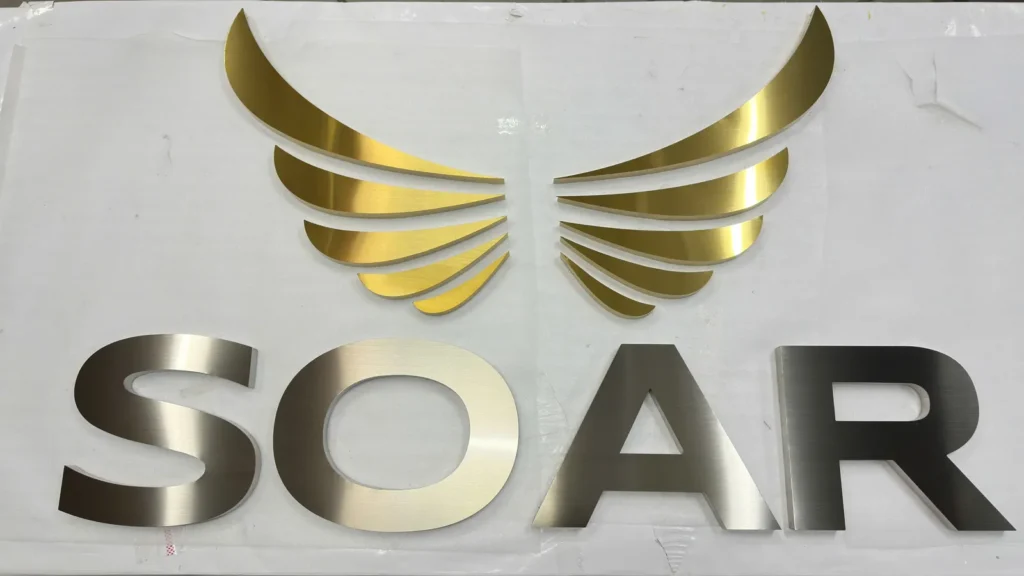
How each type looks by day and after dark
By day the two can look closer than their names suggest. A fabricated metal dimensional letter and a reverse lit (halo-lit) channel letter both show a solid metal face. A front lit (face-lit) channel letter shows a printed polycarbonate face behind a stainless rim.
Some shops call an unlit fabricated metal letter a non-illuminated channel letter. On this site it is a dimensional letter: stainless face, bent return, aluminum back, no LEDs.
After dark the two separate. Front lit: the face of each letter lights; the returns stay dark, with no glow on the wall behind. Reverse lit: the wall glows; the face reads as a silhouette. A dimensional letter has no light of its own, so it reads by daylight or by the lighting already on the wall. If the client asks whether the letters could be lit later, the answer is in the questions on the dimensional letters page.
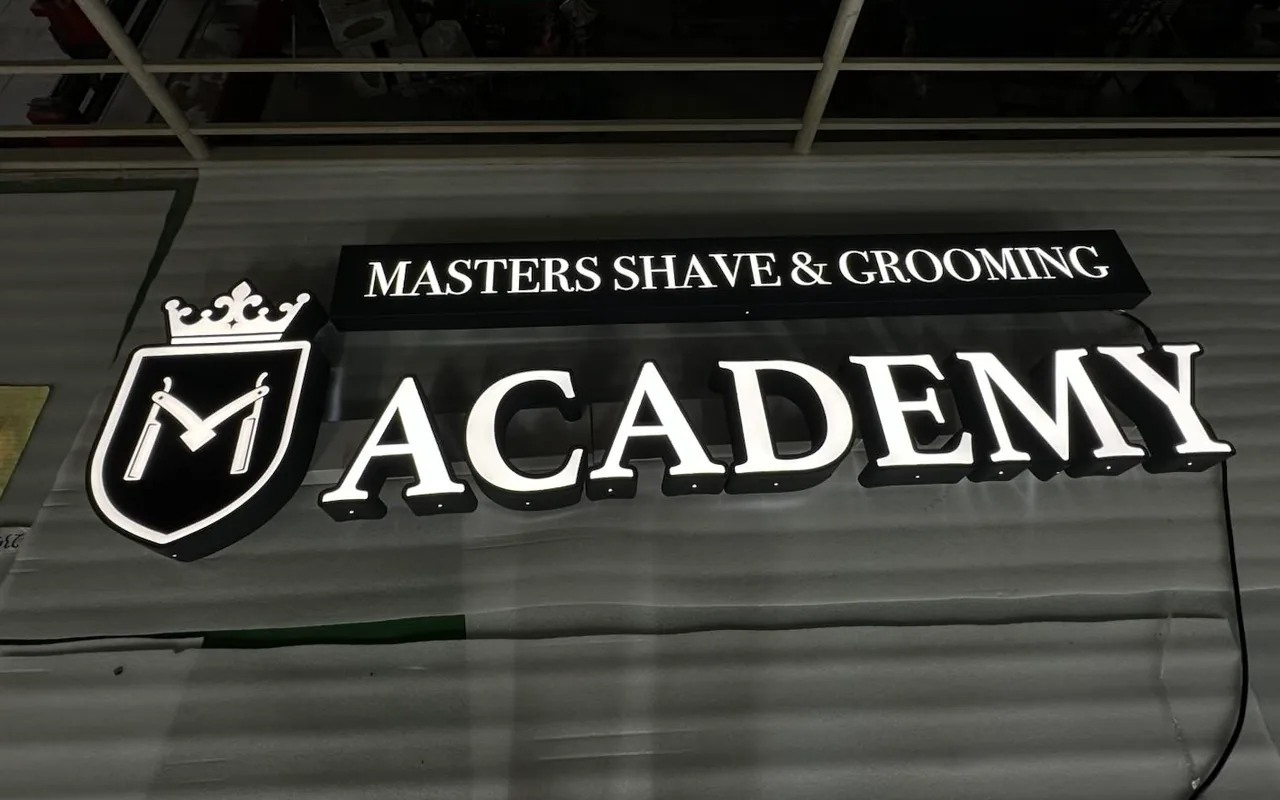
What is inside each type
| Channel letters | Dimensional letters | |
|---|---|---|
| Body | Hollow, with room for the LEDs and wiring | Metal: stainless face with a bent return, closed by an aluminum back. Acrylic: cut flat from solid sheet, no return, no back plate |
| Light | LEDs inside the letter. Reverse lit: LED modules firing back through a frosted acrylic base onto the wall | None |
| Wiring and power | LED wiring to a power supply | None |
| Choices on the drawing | Front lit (face-lit), reverse lit (halo-lit), trimless or open face, returns to your spec | Metal or acrylic for each element |
| Finish | Printed or colored faces, to your drawing | Metal left brushed, painted or powder-coated to your color; acrylic painted to your Pantone |
The parts list is also where the budget conversation starts. A channel letter set adds LEDs, a power supply and wiring, and power has to reach the wall. A dimensional set has none of that. They are two different builds, so give them two lines in the proposal, not one sign with light as an add-on.
The channel letters page shows each lighting type. If the choice is between a lit face and a lit wall, compare front lit and reverse lit channel letters.
How each type goes on the wall
Each dimensional set ships with a printed 1:1 paper pattern. Stud-mounted letters arrive with threaded studs already set in the back, the stud positions marked on the pattern and the rods cut to length. Your installer marks the wall through the pattern, drills once and hangs the letters.
Some large letters and panels get a folded metal back plate instead; your crew fastens the plate to the wall with the screws and anchors we pack, then closes the letter or panel over it.
Channel letters go up one of three ways, and the choice decides where the wiring runs:
- Raceway: one wired assembly. Your crew bolts it to the wall and brings power.
- Backer panel: one panel, all wiring behind it. Your crew mounts it and connects power.
- Flush mount: each letter goes on the wall by itself, with its own lead marked + and −.
To pick between them, see channel letter mounting options.
Channel letter crates carry a 1:1 paper pattern too. Either type ships install-ready, and your installer hangs it. See what install-ready means.
Not sure about mounting? Send a photo of the wall; our engineering team proposes the mounting method.
How to choose for the wall and the job
- Ask whether the name has to read at night. That answer picks the letter type; the next steps pick the build.
- Check for power at the sign. Channel letters need it at the wall; dimensional letters need none.
- Look at the setting. A lobby, a reception wall or a facade seen by daylight suits dimensional letters. A storefront that stays open after dark points to channel letters.
- Name the build for each element. Metal or acrylic for dimensional letters; the lighting type for channel letters. Mixed sets, such as a metal wordmark with an acrylic tagline, are built as one order; mark the material for each element on the drawing.
- Approve the mockup. You approve a mockup before production: the sign on your site photo or as dimensioned artwork, with overall size and lighting type.
A checklist for the drawing or quote request
- Lit or non-lit, for each element
- Lit elements: front lit (face-lit), reverse lit (halo-lit), trimless or open face
- Non-lit elements: metal or acrylic
- Indoor or outdoor
- Colors by PMS or RAL code
- A photo of the wall, and where power is for lit letters
- Artwork, letter height or overall width, and quantity
Questions about dimensional and channel letters
Do dimensional letters need power at the wall?
No. Metal or acrylic, a dimensional letter has no LEDs, no wiring and no power supply, so there is nothing to connect. With channel letters, your crew mounts the set and connects power.
Can I quote my client both options?
Yes. List each option as its own sign set on one request, with the drawing or artwork for each. Every job is quoted per sign set.
Do I see the letters before they ship?
Yes, twice. The mockup comes first, before production. After the build, every lit set is powered up and photographed before the crate closes, and a non-lit set is photographed finished.
Send the request
Mark lit or non-lit for each element before the drawing goes out. Send us your artwork and target quantity. You get a quote within 24–48 hours and a mockup for approval.