
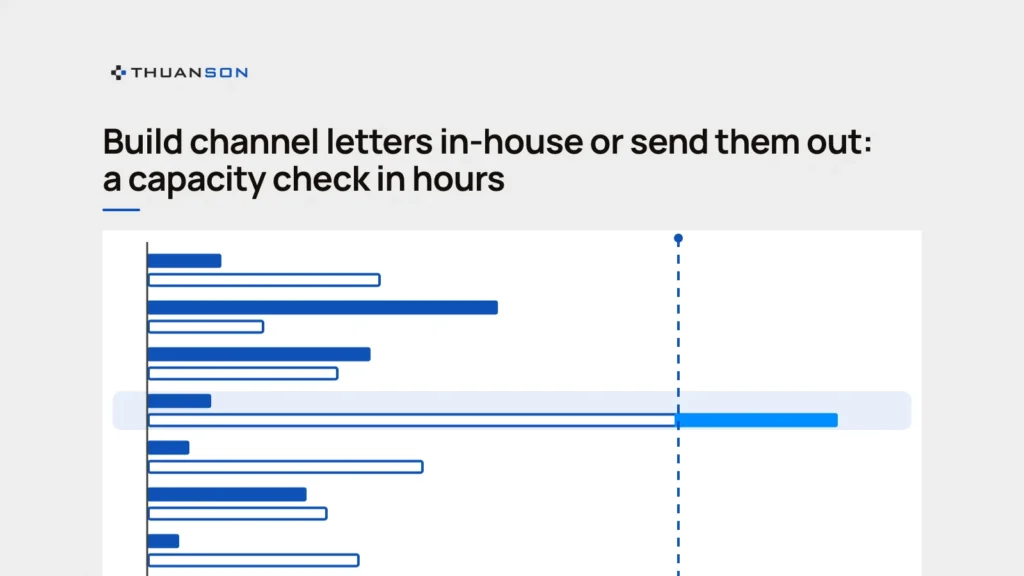
This guide is for the sign shop owner or production manager with a channel letter set on the board and an install date already fixed. We build channel letters in Hanoi for sign shops and ship them install-ready.
Count hours before you count anything else. List the stages your shop runs on a channel letter set. For each one, write the machine hours and labor hours this set needs, and the hours still free before the install date. If every stage fits, build it. If one stage doesn’t, that stage decides: move the date, or send the set out and keep your hours for work that fits.
Why the install date is decided by hours
A channel letter set does not wait in one line. The faces wait for the router, the returns wait for whoever forms them, and the wiring waits for the person who wires. The same week can have room on the router and none at the paint booth. The set is ready when its slowest stage is done, so that is the stage to find.
List the stages your shop runs
Write your own stages, not ours. For a lit set, the list might read:
| Stage | Machine hours for this set | Labor hours for this set | Hours free before the install date |
|---|---|---|---|
| File prep and layout | |||
| Cutting faces and backs | |||
| Forming returns | |||
| Assembly and paint | |||
| LED layout, wiring, power supply | |||
| Raceway or backer | |||
| Lit test and packing |
Take the hours from the last set you built at a similar size, not from the fastest one you remember. Hours already booked for other jobs come out of the free column. Leave the install off the list; your crew keeps that day either way.

Read the table: one row sets the date
Compare each hours column with the free column, row by row. A stage that needs more hours than it has free is the one that sets your date, and one such row is enough. Overtime and a second shift add to the free column; write them in only if you would really run them. If the row that fails is a machine your shop does not own, the decision is already made.
Because we have no minimum order, the check can run per job. Send out the set that fails and keep the next one on your floor.
What comes back when you send the set out
Sending out takes the set off your machine and labor hours and puts it on the calendar instead. Two numbers go into your plan. You get a quote within 24–48 hours once we have artwork, size and quantity. The lead time is about 4 weeks to your door, counted from payment and final mockup approval (typical; depends on quantity, spec and destination). To place it against your client’s date, see planning the install date back from the lead time.
You approve a mockup before production: the sign on your site photo or as dimensioned artwork, with overall size and lighting type. Every lit set is powered up and photographed before the crate closes. On a raceway build, one painted raceway carries the letters, the LED wiring and the power supply. Your crew bolts it to the wall and brings power. Every channel letter crate also holds the 1:1 paper pattern, mounting hardware, mounting drawings and the install guide.
The set ships under your name. If your client comes to us directly, we send them back to you. To know what to say when they ask who built it, see how to tell your client the sign is built by a manufacturing partner.
Questions about building channel letters in-house
Can I send out one set and keep building the others?
Yes. One set is a normal order, and every job is quoted per sign set. The sets that fit your hours stay in your shop.
Which hours stay on my schedule when the set goes out?
Two: the mockup approval, and the install. Forward the mockup to your client first if they sign off on the look. Then book your crew for the day after the crate arrives.
What do I send if I don’t know how it mounts yet?
Send a photo of the wall; our engineering team proposes the mounting method and the pattern.
Send the request
Send the artwork, the overall size and the quantity for the set that did not fit your hours. How orders from sign shops work is on the wholesale program for sign shops.